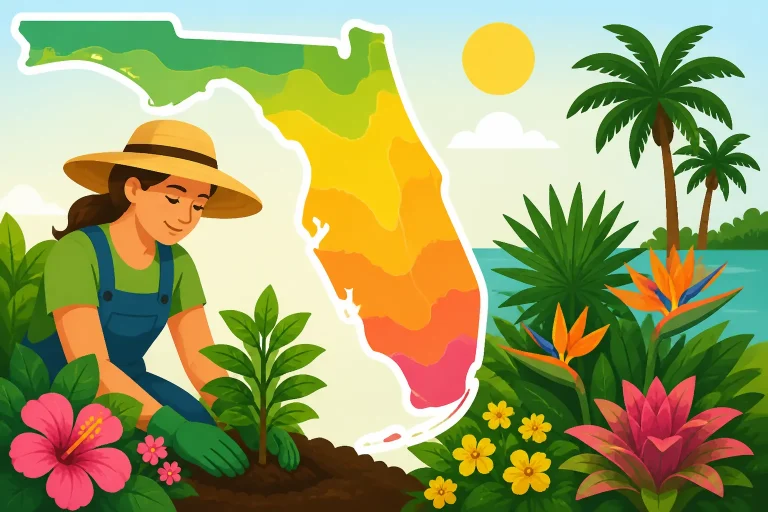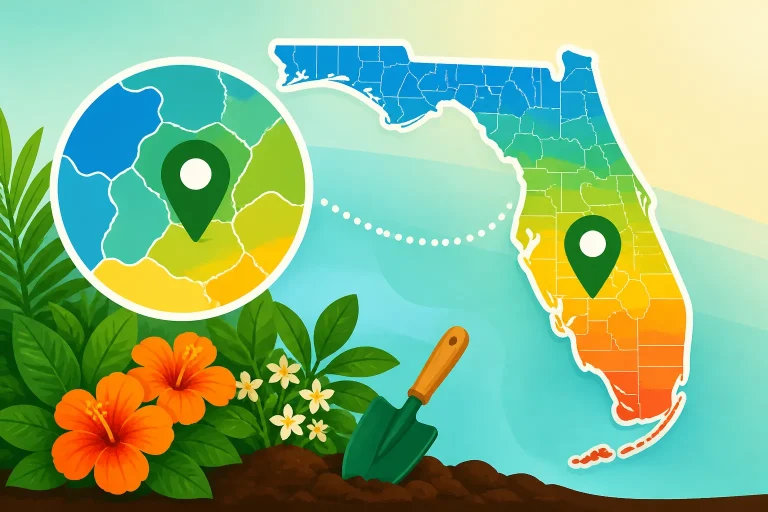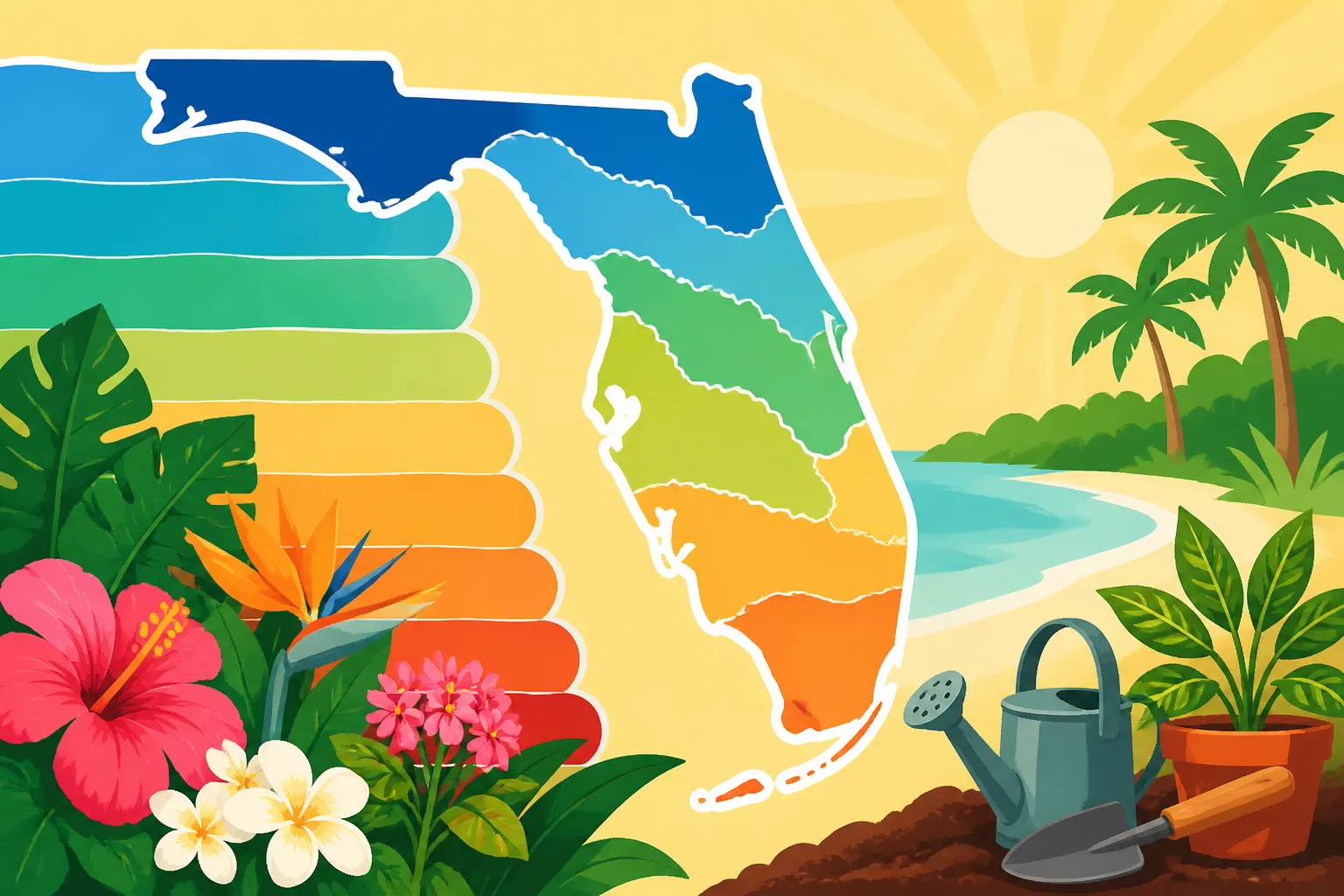
Florida Growing Zones: Planting by Hardiness Range
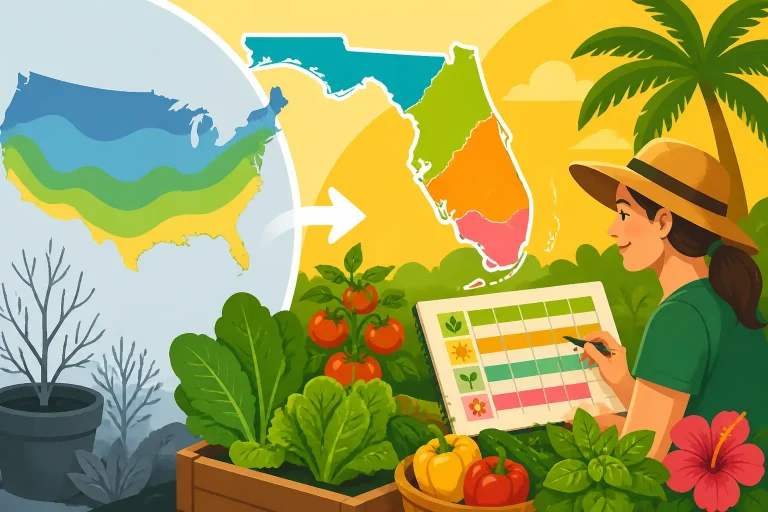
A Florida hardiness zone can help you judge whether a plant is likely to tolerate your area’s winter cold, but it cannot tell you when to sow vegetables or whether a plant will thrive in summer heat. This guide explains how to use your zone as one planning tool, then combine it with regional planting calendars, seasonal weather, and conditions in your own yard.
What a Florida growing zone tells you
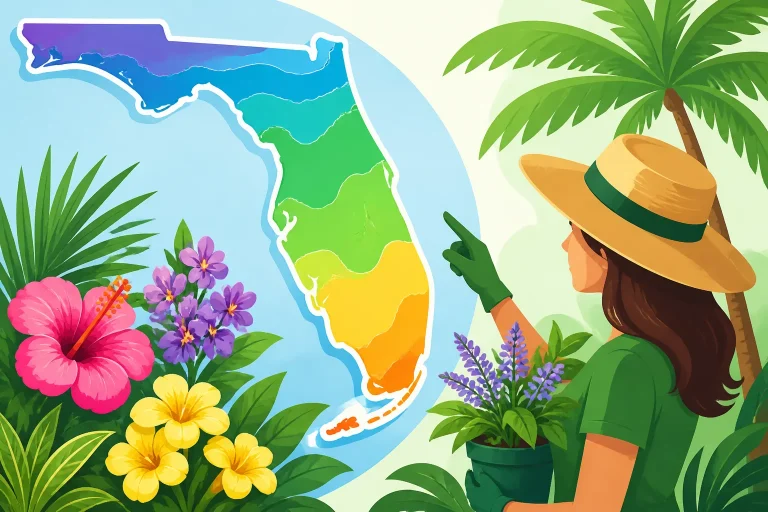
The USDA Plant Hardiness Zone Map groups locations according to their average annual extreme minimum winter temperatures. Its main purpose is to help gardeners assess whether perennial plants, such as trees and shrubs, are likely to survive the coldest conditions typical of an area.
That makes a zone useful when you are comparing plants with different cold tolerances. If a plant is not suited to the winter conditions where you garden, it may be damaged or killed during a cold spell, even if it grows well for much of the year. A map can help narrow your choices before you buy.
But a hardiness zone is not a planting calendar. It does not tell you when to start tomato seeds, when to direct-sow beans, or whether a cool-season crop will have time to mature before hot weather arrives. It also does not describe a yard’s summer heat, rainfall, soil drainage, shade, or exposure to wind.
In Florida, those differences matter. Two gardeners with the same mapped zone may have very different planting windows because one garden is inland and exposed to cold air, while the other is close to the coast. A bed beside a sunny wall may warm sooner than a low spot shaded by trees. The zone offers context, but local conditions determine much of the day-to-day gardening decision.
A useful way to think about the zone is as a screening tool:
- For perennial plants: Use it to check whether a plant is likely to tolerate local winter cold.
- For vegetables: Treat it as background information, then use regional planting guidance and weather.
- For annual flowers: Consider the season and the plant’s temperature preferences, rather than relying on zone alone.
- For fruit trees: Check cold tolerance along with the plant’s regional suitability, pollination needs, and other requirements.
- For containers: Account for the fact that potting mix and exposed roots can experience conditions unlike those in the ground.
To find the zone shown for your area, start with How to Find Your USDA Hardiness Zone in Florida by ZIP Code. A ZIP-code result is an area-level estimate, not a guarantee for a particular address or garden bed. For a closer look at what zone labels can and cannot help you decide, see Florida Planting Zones: Choosing Plants Adapted to Your Zone.
The main takeaway is simple: a hardiness zone can help you choose plants that fit the local winter, but it cannot replace a Florida planting calendar. Use the map to assess cold tolerance, and use regional and yard-level information to plan timing.
Why Florida planting decisions need more than a zone
Florida stretches across a broad range of climates. Conditions in the northern part of the state are not the same as those in the central or southern parts. Even within one region, the coast, inland areas, low-lying ground, and built-up neighborhoods can have distinct growing conditions.
That variety is why a planting decision based on a zone label alone can disappoint. A plant might be cold-hardy enough for a location but still struggle with prolonged heat, high humidity, poor drainage, or too little sunlight. A vegetable might tolerate a brief cool night but fail to produce well once temperatures rise. The zone describes one type of risk: winter cold. A successful planting plan needs to consider several types.
Seasonal timing changes from north to south
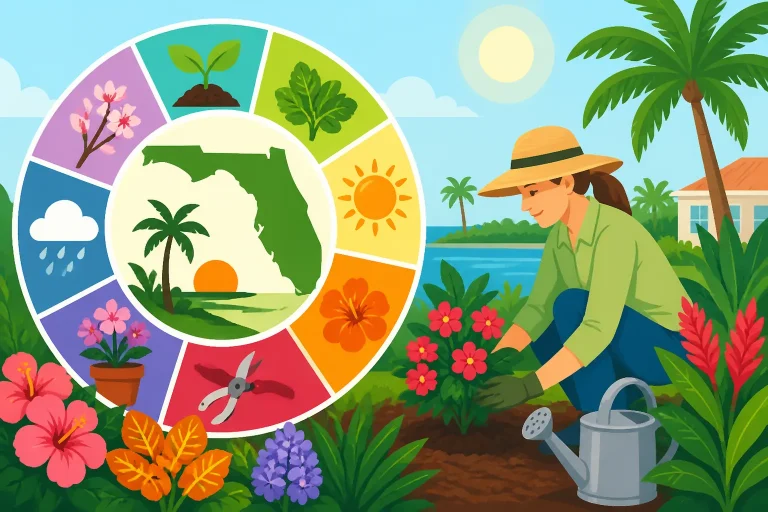
Florida gardeners commonly plan by broad regions—north, central, and south—because planting opportunities shift across the state. A cool-season crop may have a longer comfortable growing window in one region than another. Likewise, warm-season crops may be planted at different times depending on local cold risk and how soon intense heat is expected.
This regional approach is more useful for timing than trying to translate a hardiness zone directly into a sowing date. The same crop can have different recommended planting windows across Florida. Check a region-specific calendar for the crop you want to grow, then adjust for your local forecast and yard conditions.
North, Central, or South: Finding Your Florida Gardening Map can help you identify which broad planning region is the right starting point. For an overview of how the state’s seasonal calendars differ, see Beyond USDA Zones: Using Regional Florida Garden Calendars.
Cold tolerance and heat tolerance are different
A plant’s ability to survive winter does not automatically mean it can withstand Florida’s summer conditions. Some plants manage cold but struggle with heat, humidity, or wet soil. Others tolerate summer conditions but need protection if cold weather arrives.
This distinction matters especially for edible crops. A vegetable may grow vigorously in mild weather but produce poorly when temperatures climb. Another may tolerate heat but be vulnerable to a cold snap while young. The hardiness zone does not capture these crop-specific responses.
When choosing what to grow, check the plant’s temperature preferences and the season it needs to produce. For vegetables, Florida Vegetable Planting Calendar: When to Grow Each Crop offers a crop-focused way to think about timing. For varieties suited to warm conditions, Matching Warm-Season Vegetables to Your Regional Florida Climate can help connect crop choice with the local growing season.
Rain, soil, and drainage affect planting success
Florida’s seasonal rainfall patterns can shape what happens in a bed as much as temperature does. Heavy rain can leave poorly drained ground wet for too long, while sandy soil can dry quickly during a stretch of hot, sunny weather. A planting date that looks reasonable on a regional calendar may not be ideal if the soil is waterlogged, too dry, or difficult to work.
Before planting, consider whether water drains away from the bed or collects there. Think about how quickly the soil dries after rain, and whether you can provide water if a young plant needs it. These factors are not represented by a hardiness zone, but they affect roots, seed germination, and plant establishment.
A calendar provides a window, not a command. If conditions in the bed are unsuitable, waiting for a better opportunity can be more effective than planting simply because a date has arrived.
Yard features create local differences
A single yard can contain several small growing environments. A sunny area beside a building may receive more warmth and shelter than an open lawn. A low part of the property can collect cold air or hold water. Tree canopies can reduce sunlight and influence how quickly soil warms or dries.
These small differences can shift the best location for a plant or affect how early it can be planted. If a garden repeatedly gets frost damage while nearby areas do not, or if one bed stays soggy long after another dries, the difference may be a microclimate rather than a map error. See When Local Florida Microclimates Outweigh Mapped Zones for more on reading those yard-level patterns.
How to use a hardiness range when choosing plants
A zone is most useful when you compare its cold-tolerance information with the plant’s needs. It can help you rule out plants that are unlikely to survive a typical winter in your area, or identify plants worth researching further. It is not a complete verdict on whether a plant will succeed.
Check the plant’s cold tolerance first
When a plant description gives a recommended hardiness range, compare it with the zone information for your area. If the plant’s range does not include your area, winter survival may be uncertain. That does not always mean the plant is impossible to grow, but it should prompt closer research into local conditions, exposure, and protective measures.
If the plant is a permanent part of the landscape, winter tolerance deserves particular attention. A perennial shrub or fruit tree is expected to remain in place through many seasons, so repeated cold damage can become a serious problem. For an annual crop, the decision may be different: you can time planting around a favorable season and remove the plant after harvest.
Do not treat the zone boundary as a sharp line on the ground. Maps show regional patterns, while gardens experience local conditions. A mapped area does not account for every building, slope, wind exposure, or low spot. When a plant is near the edge of its suitable range, look for reliable regional recommendations rather than relying on the label alone.
Add heat, moisture, and light to the decision
Once cold tolerance looks suitable, consider what else the plant needs:
- Heat tolerance: Can it grow through warm weather, or does it need milder conditions to flower or fruit?
- Light: Does it need full sun, partial shade, or protection during the hottest part of the day?
- Moisture: Does it prefer evenly moist soil, or is it sensitive to wet roots?
- Drainage: Will the planting location drain after heavy rain?
- Space: Can the mature plant fit without crowding paths, buildings, or other plants?
- Season: Will the plant have time to establish, flower, or produce before unfavorable weather?
- Maintenance: Does it need protection, pruning, frequent monitoring, or special soil conditions?
For example, two shrubs that are both cold-tolerant may differ in their need for sun, water, and space. One may suit a sunny, well-drained bed, while the other may do better in a sheltered location. The zone helps with one part of the comparison; the site requirements help determine whether the plant matches your yard.
Treat containers as a separate growing environment
Plants in pots can face greater temperature swings than plants established in the ground. A container may heat up quickly in direct sun and cool down more quickly during cold weather. Roots are also more exposed than roots growing in the surrounding soil.
That makes a mapped zone an especially rough guide for container plants. Choose plants that suit both the general winter conditions and the pot’s location. Consider whether the container sits beside a sheltered wall, on an exposed patio, or in a spot that receives intense afternoon sun. Make sure it has drainage openings and that water can escape.
A container gives you flexibility: it can be moved to a more suitable location when conditions change. But moving a pot does not eliminate the need to understand the plant’s temperature limits or watering needs.
Use an extra margin for vulnerable plants
Plants near the edge of their cold-tolerance range can be vulnerable when a cold spell is more severe than usual. If you want to try one, avoid putting the only specimen in an exposed spot where cold air collects. Consider a sheltered location and plan how you will respond if a freeze is forecast.
For valuable trees and shrubs, choosing a plant that comfortably fits local conditions is often less work than relying on repeated cold protection. For seasonal flowers or container plants, experimentation can be easier because you can move or replace them. The right level of risk depends on how much time, effort, and replacement cost you are willing to accept.
How to plan vegetable planting by Florida region
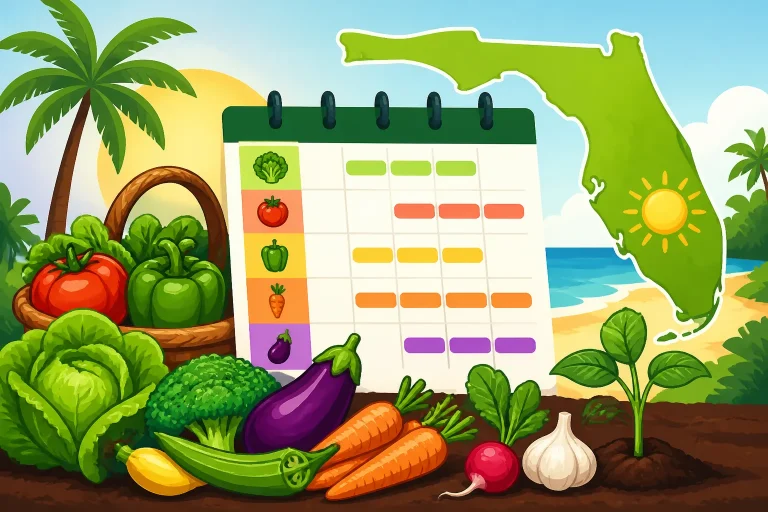
Vegetable planting calendars are organized around the conditions crops need to grow and produce. They account for Florida’s seasonal shifts more directly than a hardiness map does. Use the regional calendar as your starting point, then make a final decision based on current weather, soil, and the crop’s stage of growth.
Start with the crop, not the calendar month
A month by itself is not enough information to choose a planting date. First decide what you want to grow, then check the recommended season and planting method for that crop in your region. Some crops are best suited to mild weather, while others need warm soil and can be damaged by cold.
Also check whether the calendar recommends direct sowing or transplanting. Direct-sown seeds depend on suitable soil conditions from the start. Transplants may establish more quickly, but they can still be stressed by unsuitable heat, cold, or watering. Direct Sowing vs Starting Transplants for Florida Garden Crops explains how to weigh those options.
For more region-specific planning, What to Plant This Month Across Florida’s Three Gardening Regions can help narrow the seasonal choices. It should be treated as a starting point rather than a guarantee that the weather will cooperate in a particular yard.
Compare the planting window with the crop’s growing time
A crop needs suitable conditions not only on planting day but also while it grows. Check how long it usually takes to mature, whether that estimate is counted from sowing or transplanting, and what temperatures the crop needs along the way.
A crop planted late in its recommended window may have too little favorable weather to develop well. This is especially important when approaching a period of extreme heat or increasing cold risk. A planting window can be open on paper while the remaining growing time is already too short for a particular crop or variety.
For help estimating whether a crop has enough time, see Estimating Florida Harvest Dates Using Days to Maturity and Planting Early Enough for Vegetables to Mature Before Extreme Heat. The estimate will still depend on growing conditions. Stress from heat, poor drainage, pests, or irregular water can slow development.
Account for Florida’s two broad vegetable seasons
Many Florida gardeners plan around a cooler growing period and a warmer growing period, with the details varying by region and crop. Some vegetables are better suited to mild conditions, while others grow best once the soil and air are warmer. The transitions between these periods can be difficult because weather does not shift smoothly from one season to another.
A sudden cold snap can interfere with a warm-season planting. A run of hot weather can shorten the productive window for a cool-season crop. Check both the regional calendar and the forecast, and avoid assuming that a seasonal label means the weather has changed for good.
If a cool-season bed is ending, think ahead about what will follow it. Scheduling Vegetable Rotations Between Spring and Fall Cycles can help with planning crops in sequence, while Managing the Late Summer Transition Into Florida’s Fall Garden focuses on the changeover period.
Prepare the bed for the conditions, not just the date
Good timing cannot compensate for a bed that is not ready. Before sowing, clear competing weeds, confirm that the soil is workable, and check that water drains properly. If the bed is very dry, very wet, or compacted, planting may need to wait until conditions improve.
In sandy soil, moisture can move through the root area quickly. Raised beds and containers may need closer attention to watering than a large in-ground plot, especially after seedlings emerge. Do not assume that every bed needs the same amount of water: shade, soil texture, rainfall, and plant size all affect how quickly it dries.
If you are planning a new vegetable plot, Planning Your Florida Vegetable Plot: Soil Prep to Pest Scouting covers the work beyond choosing a sowing window. A calendar is most useful when it is paired with a bed that is ready to support the crop.
Keep notes so the next season is easier
Record what you planted, where you planted it, and what the weather was like. Note when seeds emerged, whether plants struggled after a hot or cold spell, and when harvest began. These observations help you spot patterns that a general regional calendar cannot show.
For example, one part of a yard may be ready earlier because it receives more sun, while another stays cool or wet. A note about those differences can be more helpful than relying on memory the following season. Over time, your records can help you choose the best planting window within the recommended regional range.
Adjusting planting plans for weather and microclimates
A calendar describes typical windows. Weather determines what happens in a particular season. The practical task is not to ignore the calendar, but to use it alongside forecasts and conditions on the ground.
Watch for cold risk without treating one date as a guarantee
Cold events do not occur on a fixed schedule every year. A typical planting window cannot guarantee that frost or freezing temperatures will not return. This is important when you are planting a tender crop, putting out a transplant, or deciding whether a tropical or cold-sensitive plant can remain outdoors.
Check the forecast for your own area before planting, and pay attention to the type of cold expected. Conditions can differ within a community, especially between inland and coastal locations or between exposed and sheltered parts of a yard. A nearby weather station can provide useful context, but your garden may not match its exact conditions.
For frost and freeze planning, Checking Freeze Dates for Your Nearest Florida Weather Station can help put local risk into context. Keep in mind that historical probabilities are not promises about what will happen in a particular year.
If a cold night is forecast after planting, evaluate the crop’s sensitivity and the protection available. Covering a plant may reduce exposure in some situations, but protection has limits and needs to be removed when conditions improve. How to Protect Florida Garden Beds Ahead of an Overnight Freeze provides more detail on preparing vulnerable beds.
Look for patterns in your own yard
Instead of trying to measure every detail at once, observe what happens over time. After cold weather, note which areas show damage first. After rain, look for places where water lingers. During warm weather, compare how quickly beds dry in sun and shade.
These clues help identify useful planting locations. A bed with good drainage and morning sun may suit a different crop from a spot that stays damp or gets strong afternoon sun. A protected corner may be a reasonable place to try a more cold-sensitive plant, while an open low area may be a poor choice for it.
A microclimate does not make a plant immune to bad weather. It changes the conditions around it, sometimes enough to improve the odds. If a plant’s survival depends on unusually favorable conditions, treat it as a higher-maintenance choice.
Respond to unusual heat, rain, or cold
When weather is unusually hot, wet, dry, or cold, consider whether the crop is likely to keep growing well before planting. If the soil is saturated, seeds may fail or roots may be stressed. If intense heat is forecast, a crop that prefers mild conditions may struggle even if it is within its broad seasonal window.
A short delay can be worthwhile when conditions are poor. Alternatively, you may choose another crop better suited to the current weather. Think about what you can realistically manage: watering, shade, moving containers, or protecting a bed. If the plan depends on constant intervention, a more suitable crop may be a better fit.
Avoid making a decision from a single weather reading. Check the trend as well as the immediate forecast, and watch how the soil and plants respond. Conditions can change quickly, so revisit the plan when a major weather shift is expected.
Common mistakes when planting by hardiness range
Treating a zone like a full climate description
A zone is not a complete portrait of a garden. It does not report rainfall, summer heat, soil drainage, shade, or the frequency of every cold event. A plant that is suitable by winter tolerance may still be a poor choice for the available site.
Use the zone to answer one question—whether winter cold is likely to be a major obstacle—then check the plant’s other needs. This reduces the chance of choosing something that looks suitable on a label but fails for an unrelated reason.
Using a vegetable calendar as a fixed appointment
A calendar gives a useful planting window, but it cannot predict every local weather event. Planting on the first day of a recommended period is not automatically better than waiting for soil and weather to improve. Likewise, waiting until the end of a window can leave a crop too little time to mature.
Use the whole window thoughtfully. Consider soil readiness, the forecast, days to maturity, and how long the crop needs before heat or cold becomes a problem. Recheck the plan when conditions change.
Assuming a nearby garden has the same conditions
A neighbor’s success is useful information, but their yard may have different light, drainage, wind exposure, or shelter. Their planting date may not suit your bed, particularly if one location is closer to the coast or more exposed to cold.
Use nearby gardens as clues rather than proof. If a neighbor grows a plant successfully, ask what conditions it receives and whether it needs special care. Then compare those conditions with your own.
Confusing survival with good performance
A plant can survive winter and still perform poorly. It may produce little, flower inconsistently, or struggle through summer. For edible plants, survival is not the same as a reliable harvest. For landscape plants, surviving cold is only one part of staying attractive and healthy.
When the goal is fruit, flowers, or a long-lived landscape feature, choose plants that match the full site and seasonal conditions, not just the cold-tolerance label.
Ignoring the planting method
A seed planted directly in the ground and a transplant set into the same bed experience different starting conditions. Seeds need an appropriate environment for germination and early growth. Transplants need time to establish and can be stressed by sudden changes in temperature or water.
Check crop-specific guidance before deciding how to plant. A method that works well for one crop or season may not suit another. The calendar and planting method should be considered together.
A practical way to make a planting decision
When you are deciding what to plant, work through the questions in order. This keeps the zone in its proper role and makes it easier to see what information is still missing.
- Identify the plant and its purpose. Decide whether you want a perennial landscape plant, annual flower, vegetable, or fruit tree. The consequences of a poor fit differ: a missed vegetable crop is temporary, while a landscape tree is a long-term commitment.
- Check cold tolerance. Compare the plant’s recommended hardiness range with the zone information for your area. If the fit is marginal, look for regional advice and consider a sheltered location.
- Find the right regional calendar. For vegetables and other seasonal crops, choose guidance for your part of Florida rather than relying on a statewide month alone.
- Check the crop’s temperature preferences. Confirm whether it favors cool or warm conditions, and whether it is sensitive to frost, heat, or both.
- Estimate whether there is enough growing time. Use the crop’s days to maturity and compare that with the likely length of favorable conditions.
- Evaluate the planting site. Check sun, drainage, exposure, available space, and how easily you can provide water.
- Look at current and expected weather. A suitable calendar window does not remove the risk of an unusual cold snap, intense heat, or heavy rain.
- Choose a backup plan. If conditions turn unfavorable, decide whether to delay, protect the plant, move a container, or switch to a more suitable crop.
- Record the result. Keep notes about the planting date, weather, and outcome to improve next season’s choices.
This sequence works for both new and experienced gardeners because it separates different questions instead of asking the zone to answer everything. For a perennial, cold tolerance may be the first major filter. For a vegetable, the regional calendar and growing time may matter more. For either, the garden’s actual light and drainage can change the final choice.
Frequently Asked Questions
Does a Florida hardiness zone tell me when to plant vegetables?
No. It helps assess a plant’s ability to tolerate winter cold. Use a regional vegetable calendar, crop-specific guidance, and current weather to decide when to sow or transplant.
Can two gardens in the same zone have different planting windows?
Yes. Coastal exposure, inland location, shade, drainage, buildings, and low spots can create different conditions within the same mapped area. A zone is an area-level guide, not a description of each garden.
Should I choose a plant just because its hardiness range includes my area?
Not necessarily. Check heat tolerance, sunlight, moisture, drainage, mature size, and seasonal needs as well. The hardiness range addresses winter cold, not every factor that affects growth.
Is a planting calendar a guarantee that weather will be suitable?
No. A calendar describes a recommended window, but weather varies. Check the forecast and conditions in the bed before planting, especially when a crop is sensitive to cold, heat, or excess moisture.
Disclaimer
This article is for general informational purposes only and does not constitute professional advice. Laws, prices and regulations vary by location and change over time. Consult a qualified professional for guidance on your specific situation. Florida Gardening Guide is not a government agency and is not affiliated with any university extension, state department of agriculture or other government agency.